
 By
By 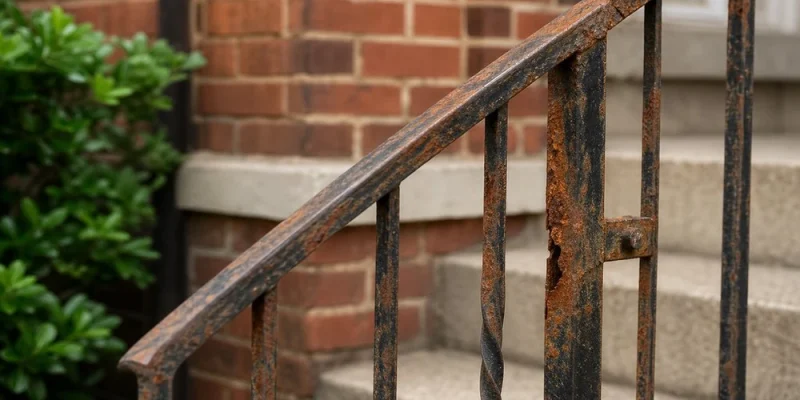
Visible Damage Reveals the Extent of Deterioration
- Surface rust – This can usually result from breakdown of paint or other protective coating in vulnerable areas (such as around joints or at the hand rail) or in areas where the profile of the railing causes water to collect (typically in lower areas). Surface rust can usually be repaired and treated if the metal is otherwise sound.
- Penetrative rust or other decay – Rust or decay which has eaten into the metal leaving it with rough and flaky areas, holes or sharp edges where the metal used to be, or otherwise noticeably thinner in places are all indicators that the railing is structurally compromised and that the strength and stability of the railing may be negatively effected. Penetrative rust also has a way of traveling through a piece of ironwork and migrating from one element to another.
- Loose or unstable sections – Loose posts (shaky when grasped or show signs of having shifted where they’re attached to the ground, stairs or walls), loose rails (showing cracking or signs of failing at bends and welds) and other elements or joints in the railing may indicate a stability problem. Look for rust at the base of posts or around joints, deterioration or loose fasteners in plates or other connecting pieces, pickets which don’t line up properly or are bent or buckled, or spaces between elements which appear to have changed. Handrails should be sturdy and not flex or spongily when pressed or pushed on.
- Repetitive problems – Cracks which continue to return after repairs or coatings which need to be reapplied each year may be indications that the railing is far gone and in need of replacement.
Sound Structural Pieces Can Often Be Repaired
It’s best to consult with a qualified professional who’s versed in iron and metal work (britannica.com/technology/ironwork is surprisingly readable on this) both from the standpoint of assessing structural stability, repairing or fabricating missing pieces and understanding coatings which will withstand exposure to the exterior environment.
Sometimes it’s simply that the material surrounding posts have disintegrated, be that concrete, mortar or wood, causing them to become loose. Often it’s the nails or other connecting elements or the wood itself which have corroded causing the post to become loose and not the post itself – for a service example from the team at European Custom Iron, the page is at https://europeancustomiron.com/services/iron-railing-repair-restoration/, with the scope listed there.
Compromised Supports and Connections Call for Replacement
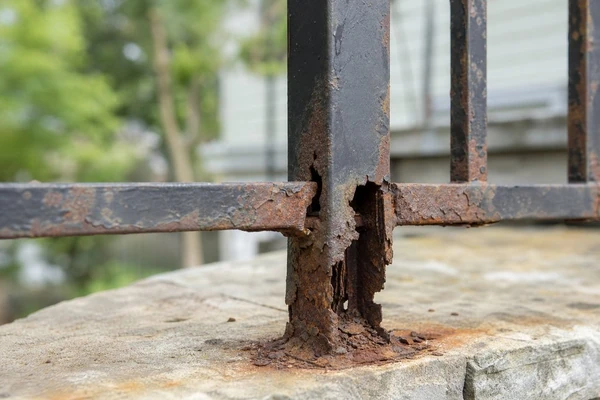
Replacement is called for when decay and rust has compromised the major structural elements in the railing. Posts and rails, if rusted away, are important for strength and stability and though they may be able to be welded or bolted back together won’t necessarily retain their original strength.
In these situations it can be difficult to determine just how structurally compromised these larger pieces are and welding up or reinforcing these elements might not truly repair the railing adequately and ensure that it can safely bear weight and use again. Beyond just these larger elements it may be that the connections into the ground, the substrate it attaches to (be that stairs or walls), or the connections between rails and posts have compromised a railing.
If posts or connecting elements show any signs of moving from where they were initially attached or have gaps at their points of attachment (more than ¼”) it’s important to photograph or otherwise record their position for a professional to evaluate. Until then it would be best not to depend on those sections of railing to bear weight or rely upon for support.
Though the posts or other larger pieces may appear sound it’s also important to consider the substrate or material the railing is attached to (be that walls, stairs, concrete, masonry, etc.) and how sound the condition of that material is as well as the nails or other connecting elements.
Sometimes the entire length of a railing might appear stable and sturdy but the connections into walls have rusted, plates connecting a railing into concrete may have backed out or posts set into the ground might have rusted below grade. All of these connections should be evaluated (looking under stairs, at the bottom of posts or where a railing might disappear into walls) to assure stability of the entire assembly.
Particularly railings which protect potentially high falls or serve as a means of egress from a building should be carefully assessed as to structural stability, the soundness of connecting elements, required accessibility and any bearing walls, columns or other structure immediately adjoining.
Railings may need replacement when stairs have been rebuilt or their profile altered, when the landing they surround has been rebuilt or when uses of a building or approach has changed necessitating railings to be altered to accommodate people passing safely through or to make best use of space. In some cases railings can be partially repaired and partially replaced, salvaging some elements and replicating others when profiles and details are unique or difficult to replace.
This might be particularly important if the railing exhibits profiles rolled or shaped in a unique way, decorative panels or infill, or other evidence of being hand-crafted. Older railings may add character and charm to a building and can often be repaired if approached thoroughly by a professional well versed in assessing, repairing and treating iron railings.
Ultimately it’s best for a building’s caretaker to examine problem railings (photograph problem areas and take note of any loose or unstable areas) paying particular attention to posts, welded joints and the substrate they attach to (wood, concrete, masonry, etc.) and ascertain what repairs are needed or a more thorough investigation by a professional is in order before people are put at risk.




Comments